
Our Location
Le-Pelle
1511 Locust St
Walnut Creek
CA 94596
Directions & reviews on Google ›
Hours
Sun – Fri: 9:30am – 6pm
Sat: Closed
Mail: lepelle.site@gmail.com
Phone: (925) 476-5343
Get in Touch




Hot, bone-dry summers in the lee of Mount Diablo followed by damp, cold winters pull moisture out of the outer skin layer faster than it can be replaced. Once that layer stops holding water properly, fine lines read deeper, pigment spreads unevenly and redness stops settling on its own. This is environmental aging and it runs separately from sun damage. Repairing it means rebuilding the barrier, not booking a relaxing facial, which is the approach Le-Pelle takes in Walnut Creek.
Skin in the Diablo Valley ages on a different schedule than skin a few miles west, and sun exposure is only part of the reason. Our summers sit hot and bone dry in the lee of Mount Diablo. Winters arrive damp and cold. That repeated swing pulls moisture out of the outer layer of the skin faster than it can be replaced, and once that layer stops holding water properly, lines read deeper, pigment spreads unevenly, and redness stops settling down on its own.
Skin professionals call this environmental aging. It runs separately from the aging written into your genes, which means it responds to what you do about it.
Your skin’s outermost layer, the stratum corneum, works like a brick wall. Dead cells are the bricks and a matrix of lipids is the mortar holding them together. Its job is to keep water in and irritants out.
Transepidermal water loss is the moisture that evaporates out through that wall into the surrounding air. It happens constantly and at a healthy rate it is nothing to worry about. When ambient humidity drops across Contra Costa County, the dry air pulls harder, water leaves faster than the skin can replenish it, and the mortar between those cells begins to fail. Microscopic cracks open. The wall stops being a barrier.
Everything that follows is downstream of that one failure.
A compromised barrier shows up in three predictable ways, and they tend to arrive together rather than one at a time.
There is nothing wrong with a spa facial. Steam, massage and a pleasant hour do real things for stress, and stress affects skin. But understand what that treatment reaches.
Steam and a generic moisturizer work on the surface of the stratum corneum. They sit on the wall. They do not rebuild the mortar, they do not clear the layer of dead sun-damaged cells blocking anything useful from getting through, and retail formulations are blended for unsupervised use, which caps how strong the active ingredients are allowed to be. You get a genuine glow that fades within days, because nothing structural changed.
Barrier damage is a structural problem. Structural problems need treatments that reach past the dead surface layer.

Three things have to happen, in order. Skip the first and the rest cannot work.
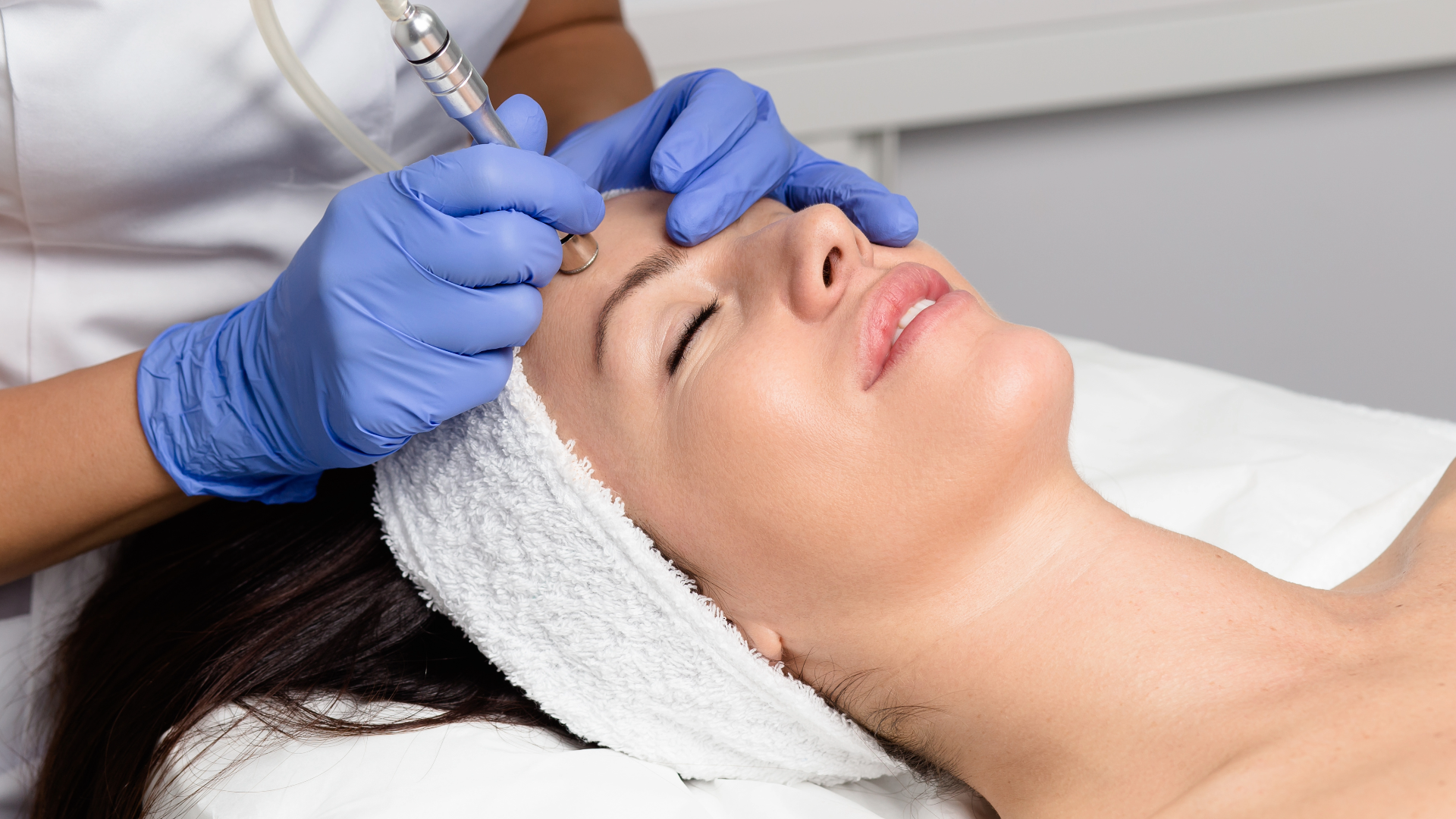
The layer of dead, sun-damaged cells has to come off before anything can be delivered underneath it. That is achieved mechanically, or with acid solutions matched to your skin’s current tolerance. A chemical peel does this chemically and at a controlled depth. Hydrodermabrasion combines the clearing step with hydration, which suits skin that is already stressed and cannot take an aggressive approach.
With the path open, concentrated formulations reach living tissue: vitamin C to interrupt pigment production, peptides to signal repair, hyaluronic acid to draw water back into the tissue and hold it there. Concentration and formulation quality are what separate these from what is available over the counter.
Collagen synthesis is the slow part and it cannot be rushed with a cream. Controlled injury does trigger it, which is the principle behind micro and nano needling and behind radiofrequency treatment. Then the skin is sealed with lipid-replenishing formulations that put the mortar back, plus daily broad-spectrum protection so the cycle does not restart.
Between professional treatments, a few habits carry most of the weight here.
Which professional treatment suits which part of the year is a separate question, and it matters more here than it would in a stable climate. We have mapped that out in which skin treatment to book in each season if you want the schedule rather than the habits.
Both, on different timescales. In the short term dehydration exaggerates lines that are already there, and they soften once the barrier recovers. Over years, a barrier that is repeatedly compromised allows more inflammation and more UV damage to reach the structures underneath, and that damage is cumulative.
Regularly, and it is one of the most misread conditions we see. Oil production and water content are separate systems. A damaged barrier losing water often triggers more oil in response, so skin can feel greasy and be dehydrated at the same time. Treating it as simple oiliness with stripping products makes both problems worse.
Most people notice within their first dry season. Skin that behaved predictably in a humid or coastal climate starts feeling tight by midday and reacting to products it previously tolerated. That is the barrier adjusting to a steeper moisture gradient, and it is the right moment to get ahead of it rather than wait for pigment and lines to settle in.
Barrier condition is not something to guess at from the mirror. It is assessed, and the sequence of treatments that follows depends on what is actually happening in your skin rather than on what the season is doing to everyone else.
If your skin has stopped responding to what used to work, book a consultation with our team in Walnut Creek and we will look properly. You can also browse our treatments to see how these approaches are applied.
Le-Pelle
1511 Locust St
Walnut Creek
CA 94596
Directions & reviews on Google ›
Hours
Sun – Fri: 9:30am – 6pm
Sat: Closed
Mail: lepelle.site@gmail.com
Phone: (925) 476-5343
 Which Skin Treatment to Book in Each Season